
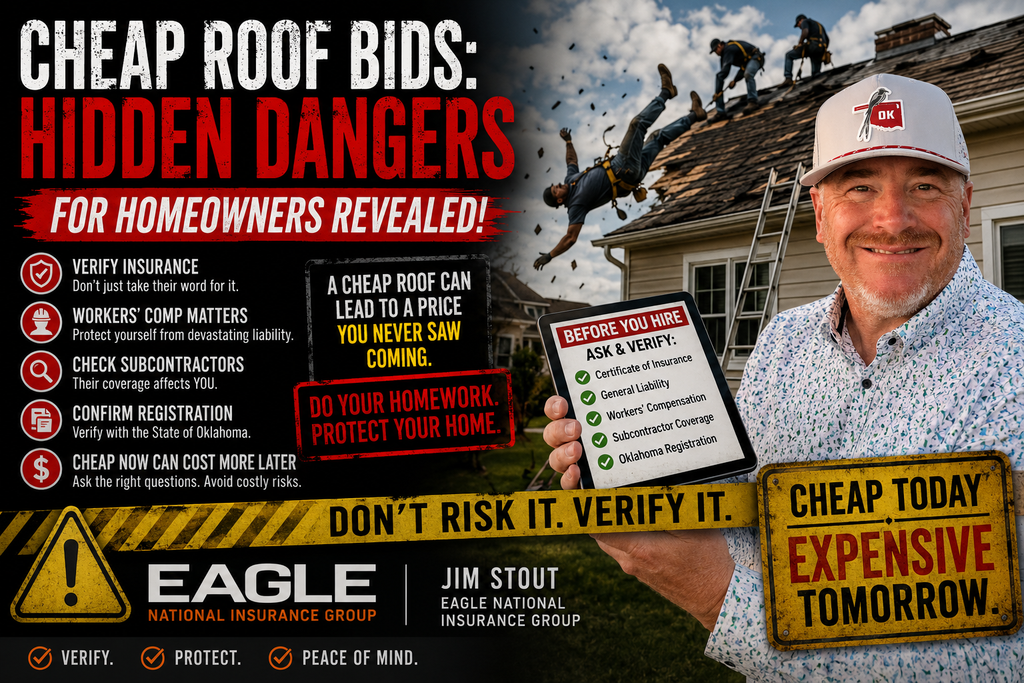
By Jim Stout, Eagle National Insurance Group — Tulsa, Oklahoma
A storm rolls through Northeast Oklahoma, your shingles take a beating, and you do the responsible thing: you get three estimates. Two land in the same neighborhood. The third comes in thousands of dollars cheaper.
Before you sign that one, ask the question almost no homeowner thinks to ask — not whether the roofing contractor is cheaper, but why. Because the answer is usually insurance, and if you get it wrong, the injury that happens on your roof can become your family’s financial problem.
Why the cheapest roof bid is usually the cheapest
Shingles cost roughly the same for everybody. So does labor, so does the dumpster, so do the permits and the fuel to haul it all to Green Country. When one bid is dramatically lower than the other two, the savings almost never come out of the materials. They come out of the overhead.
And a large piece of a legitimate roofer’s overhead is insurance. Good contractors carry general liability. They carry workers’ compensation. They register with the state. They collect certificates from every subcontractor they use. Every one of those things costs real money, and all of it shows up in the bid. A contractor who skips them can underbid everyone in town — right up until something goes wrong.
What actually happens when a roofer falls off your house
It’s a Tuesday morning. Six guys are on your house tearing off shingles. One loses his footing, falls two stories, and hits the ground.
This is not a few stitches. This is an ambulance in your driveway, surgery, weeks in the hospital, months of rehabilitation, and potentially a permanent disability that ends a man’s career at forty-two. Somebody pays for all of it. The only question is who.
If the roofing company carries workers’ compensation and the injured man is their employee, the comp carrier handles it and you never hear about it again. But residential roofing crews are very often subcontractors rather than employees — so the answer depends on whether those subcontractors carry workers’ comp. Maybe they do. Maybe there is no policy anywhere in the chain.
When there’s no coverage anywhere in the chain, the injured worker and his attorney start looking for someone who does have coverage. That search has a way of ending at the homeowner. Your homeowners liability coverage may respond, but it was never designed to absorb a catastrophic workplace injury, the limits are often a fraction of what such a claim is worth, and many policies restrict coverage for uninsured workers injured on your property. That is a conversation you want to have with your agent before the ladder goes up, not after.
General liability and workers’ comp are not the same thing
This is where most homeowners get tripped up, because a contractor says “I’m insured” and the conversation stops there.
“I’m insured” is not an answer. Insured for what?
- General liability responds when the contractor damages your property — a dropped bundle through a skylight, a truck backed into the garage door. It does not cover an injured worker.
- Workers’ compensation covers the person who falls off your roof.
They are two separate policies doing two separate jobs, and having one tells you nothing about whether they have the other. When a roofer hands you a certificate, it needs to show both.
“Everybody’s a 1099 subcontractor” is not an answer either
If you hear “we don’t need workers’ comp because everybody’s a 1099 subcontractor,” treat that as your cue to ask more questions, not fewer.
Oklahoma does not decide employment status based on which tax form somebody receives. The state looks at control — who directs how, when, and where the work gets done. A crew that shows up in the company truck, in company shirts, taking direction from the company foreman may well be employees no matter what the paperwork says. We’ve watched Oklahoma business owners find that out the expensive way, after the state reclassified the “contractors” they’d been paying on a 1099.
That’s the contractor’s problem to solve. It becomes your problem when the misclassified worker gets hurt on your roof and discovers there’s no comp policy to file against.
What Oklahoma actually requires of roofing contractors
Oklahoma has more rules here than most homeowners realize, and knowing them turns a vague worry into a specific question you can ask.
Registration is mandatory. Resident and nonresident roofing contractors must hold a valid registration from the Oklahoma Construction Industries Board to perform or even offer roofing services in this state. Registration renews annually. Working without it is a misdemeanor carrying a fine of up to $500.
There are minimum liability limits. A registered residential roofer must carry at least $500,000 in general liability coverage. Commercial roofing work requires at least $1,000,000 plus a separate commercial endorsement earned by exam.
Workers’ comp — read this part closely. To register, a roofer must show evidence of workers’ compensation coverage or an exemption from coverage. That second option matters enormously. A roofing contractor can be fully registered, fully legitimate on paper, and still have no workers’ compensation policy at all. Registration alone does not answer your question. You have to ask the question.
A new requirement is coming. Under House Bill 1628, Oklahoma is phasing in a Residential Roofing Endorsement. The transition window opens January 1, 2027, and the endorsement becomes mandatory for all residential roofing work on January 1, 2028. It’s worth asking any roofer you’re considering whether they’re on track for it — the ones who are paying attention will know exactly what you’re talking about.
The checklist: what to do before anyone gets on your roof
- Ask for a certificate of insurance showing both general liability and workers’ compensation. Not one. Both.
- Have it sent directly from the contractor’s insurance agent, not handed to you as a photocopy or a phone screenshot. A certificate that comes straight from the agency is a certificate that’s current.
- Check that the company name on the certificate matches the name on your contract, exactly. Different names on those two documents is a genuine red flag.
- Verify the registration yourself using the CIB’s Are They Licensed? lookup. It takes about a minute.
- Ask the subcontractor question: “Do you require every subcontractor working on my property to provide proof of workers’ compensation before they start?” A good contractor answers this instantly, because he’s already collecting those certificates.
- Get the answers in writing, in the contract, before any money changes hands.
Frequently asked questions
Does a roofing contractor have to carry workers’ compensation in Oklahoma?
It depends on how the business is structured. Oklahoma generally requires coverage once a business has employees who aren’t immediate family or genuine independent contractors, and sole proprietors with no employees can file for an exemption. That’s exactly why “he’s registered with the state” isn’t enough — a registered roofer may be operating under an exemption with no policy in place.
Can I be sued if a roofer is injured on my property?
You can be named in a claim, yes. Whether it goes anywhere depends on the facts and on who else in the chain carries coverage. The practical protection is making sure somebody above you in that chain has a workers’ compensation policy that responds first.
Will my homeowners insurance cover an injured roofer?
Possibly, in part — but homeowners liability was never built for a catastrophic workplace injury, and limits and exclusions vary widely between policies. Have your agent read your actual policy before you hire anyone.
What’s the difference between general liability and workers’ comp on a certificate of insurance?
General liability covers damage the contractor does to your property. Workers’ compensation covers injuries to the people doing the work. You want to see both listed, with active dates that cover your project.
How do I check if a roofer is registered in Oklahoma?
Use the Construction Industries Board’s “Are They Licensed?” search. Confirm the registration is active and that the business name matches your contract.
Before you sign, let us read the certificate
If you’re staring at three bids and you’re not sure what you’re looking at, send them to us — specifically, send us the certificates of insurance.
We’ll read them, tell you exactly what’s covered and what isn’t, and flag what’s missing. No charge, no obligation, and you don’t have to be a client. It takes us a few minutes, and it’s the same review we’d want somebody to do for our own families. While we’re at it, we can look at your homeowners policy and tell you honestly how much of this risk it would actually absorb.
Doing it right on the front end is a lot cheaper than finding out what happens when somebody doesn’t.
Eagle National Insurance Group, Inc.
20 E 5th St, Suite 1203, Tulsa, OK 74103
Call or text: (918) 213-4443
Email: info@enatinsurance.com
Serving homeowners and business owners across Tulsa, Broken Arrow, Owasso, Jenks, Bixby, Claremore, Bartlesville, Muskogee and all of Green Country.
This article is general information, not legal advice or a statement of coverage. Policy language, state requirements, and individual circumstances vary — talk to a licensed agent about your specific situation.